Ten Characteristics of a Blog and a Quality Blog Post
Sometimes an online journal, other times an
informational website, a blog is the internet’s way of indulging
opinionated writers and coaching curious readers. It’s a place within
the online universe where individuals (or groups of them) may voice
their thoughts and share them with millions.
The blog’s definition is somewhat elusive, and the ways to describe it are numerous.
The most popular blogging niches tackle personal finance and development, health and fitness, beauty and fashion, and everyone’s favorite – food blog.
Blogs can be deeply personal and introspective, resembling an online
diary. When written by professional journalists, they possess enough
power to influence business and politics.
There must be something mutual to all of them, right? Some universal characteristic in an otherwise multifarious world?
Ten characteristics of a blog
We’ve done some counting and ended up with ten main characteristics of a blog:
1. A Blog Must Always Be Dynamic
A common question about a blog is how it
relates to a website – are these two essentially the same, or are there
any differences between them? While websites are mainly presentational,
blogs are always intended to engage. A website is therefore static, as
opposed to a blog that must be dynamic.
The information offered by websites is
presented on static pages, in the form of an evergreen content that
doesn’t require any updates. Blog posts, on the other hand, are like
diary entries; they include a publishing date and meta tags. New entries
and regular updates are key to running any kind of blog.
2. Posts Are Displayed in Reverse Order
Unlike with a personal diary written in a
notebook, blog entries are displayed in reverse chronological order –
the newest posts being on top. The latest ones push previously published
ones down the list until they completely disappear from the landing
page. Older posts are usually archived on the following pages, but they
can also be organized by the month or year when they were first
published.
3. Most Blogs Have the Same Structure
First comes a header with the menu or
navigation bar to declutter the page and make a great first impression.
It’s followed up by the main content area on which blog posts appear
either by order of publishing or by relevance. Down below are contact
pages, privacy policies, and relevant links, neatly arranged in a
footer. A sidebar highlights favorite entries and displays social
profiles and call-to-actions.
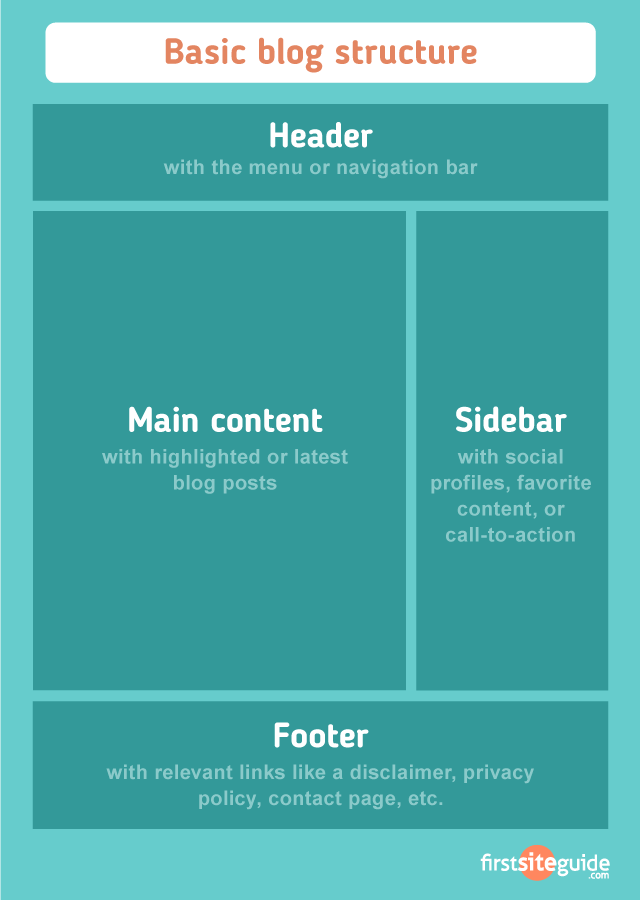
Feel free to use this template on your site
4. The Blog’s Leading Star Is Its Content
Different blogs publish different types of
posts, though a majority of them relies on the power of the written
word. Depending on the author’s intention, an article is typically an
opinion piece, an instructional guide, or a news post. Monotonous chunks
of text are separated with images or videos.
A blog post can also be a picture with little or no text. It’s a common trend in fashion and travel blogs,
though it’s also not rare for business-related niches to publish
infographics instead of instructional articles. But regardless of the
medium, a blog is always defined by the quality of its published
content.
5. Headlines Should Be Attention Grabbers
Naming a blog post is an art by itself. There’s a whole philosophy behind writing article headlines
– a compelling one can truly silence the noise, instantly generating
clicks, driving traffic, and enticing a reader to read on. Nowhere in
the online universe are titles given the same kind of attention as here.
6. One Rule Applies to All Blogs: Relevancy
Though every engaging content must be
relevant, this rule especially applies to blogs posts. They might differ
in types, mediums, formats, and styles; in order to arouse interest or
evoke debate, they have to be original and unique; but to be read at
all, blog posts must always deliver upon their promise.
7. Blogs and Links Go Hand in Hand
As a promotional strategy, link building
is not limited to blog posts, but it definitely is a characteristic
that all decent blogs share. Blogs and links go hand in hand even when
marketing isn’t the goal. Internal linking, for instance, ensures
intuitive navigation between mutually relevant posts, thus providing an
exceptional reading experience. It’s about the flow and facilitation of
knowledge transfer.
8. A Blog Is Founded on Personal Touch
The word “blog” derives from an earlier
version “weblog”, which initially referred to personal online journals.
Before blogs became political in the early 2000s, they were merely means
to make private thoughts and opinions public. The personal touch,
however, remains their vital characteristic to date.
Even with today’s universal topics, the
recommended interpretative approach is the one that implies uniqueness.
If the subject matter requires utmost objectivity, the personal touch is
accomplished through an individualistic writing style. Every blog
author has an “About Me” page and a distinct signature mark.
9. Posts Should Always Encourage Debate
The comment section is another mutual
characteristic of respectable blogs. It’s typically located at the end
of every post, as a place for readers to engage in a conversation and
leave their honest feedback. The ability to provoke a response and
encourage interaction is held in the highest regard by all readers.
10. All Blogs Are About Communication
With or without open debate, communication
is still the end purpose of each and every blog post. If the blog is
promotional, its goal is to attract the audience and open a dialogue
that will hopefully convince them to buy what the owner is selling. If
not about sales, then it’s about spreading the word.
Whether it imparts knowledge, provides
solutions, or simply entertains, blogging is a brilliant way of reaching
out and communicating with the world. Without any question at all, such
a transformative power of free expression and exchange is the single
most important characteristic of any terrific blog.
Characteristics of a quality blog post
Every blog post requires time and effort. The time spent on creating quality posts translates directly into more clicks and higher site traffic, making the investment worth it.There are many things that can influence the quality of your blog posts, and it all mostly depends on your niche, style, and audience. However, no matter how diverse the blog posts are, there are still a few things that everyone should pay close attention to if they want to leave an overall good impression on their readers.
Thought-out Design
We’ve already touched upon the topic of monotonous chunks of text and how undesirable they are in blog posts. The reason behind this being how quickly your readers make a judgment about your post. You have just about 50 milliseconds to make a good first impression.Blocks of text are often overwhelming, and if the readers cannot scan through the text with ease, they’ll move on from your site. So, make sure to use short paragraphs, break up the text with some interesting visuals such as images, GIFs, videos, infographics, etc.
Perfect Length
One of the most common questions about blog posts is how long they should be. The simplest answer is long enough.Most would believe that because of the shorter attention span of readers, the posts themselves should be shorter.
The fact of the matter is that as long as your post is informative and as long as it answers your audience’s questions, it doesn’t matter how long it is.
If you have a 500-word limit but have much more to say on the topic, go right ahead. On the other hand, don’t spread out 500 words worth of content to 3000 words.
The focus should be on the quality of the content. As long as the blog post offers value to the reader, its length is unimportant.
Original Content
Regardless of the niche you choose for your blog, it’s more than likely that someone has covered the topic before. Everything’s already been said and done, but this doesn’t mean you should just copy-paste the content.Primarily, to stand out from the crowd, you need to offer a new approach to the covered topics. This can be done with your tone of voice, style of writing, or point of view.
Going back to that “personal touch”, if you’ve chosen a niche that you’re passionate about, offering your own unique approach to it shouldn’t be difficult.
Great Research
Every high-quality blog post requires time and effort invested in the research. The more you devote yourself to the research, the easier it becomes to write the post.Primarily, this will give you insight into other’s opinions on the topic, you’ll dive deeper into it, making it easier to form your own unique approach to it.
Secondly, the easiest way to lose readers is by being unreliable. Every claim should be backed up by evidence, so links and citations from credible sources are essential.
Ready to start a blog on your own?
Starting your own blog is done in a few steps. First, you need a name for your blog and to choose the blogging platform. We strongly recommend WordPress.org, the self-hosted platform.Once you decide on your name you will need to choose a web hosting service. For new bloggers, we recommend Bluehost, a company that powers over 2 million websites worldwide. You will get a Free domain name when you sign up with them and they offer a 30-day money-back guarantee.
Bluehost web hosting company is recommended by WordPress.org as one “of the best and brightest of the hosting world”.

Conclusion
The blog’s definition may be elusive, but
that’s fine. As any blogger can testify, the allure of this practice
stems from its diversity. The previous characteristics are thus more
what you would call guidelines than they are uniform rules, except for
one common denominator. Communication remains the essence of blogging,
while everything else serves to help us engage, entice and delight our
readers.


Nice post.
ReplyDeleteThanks for sharing.